
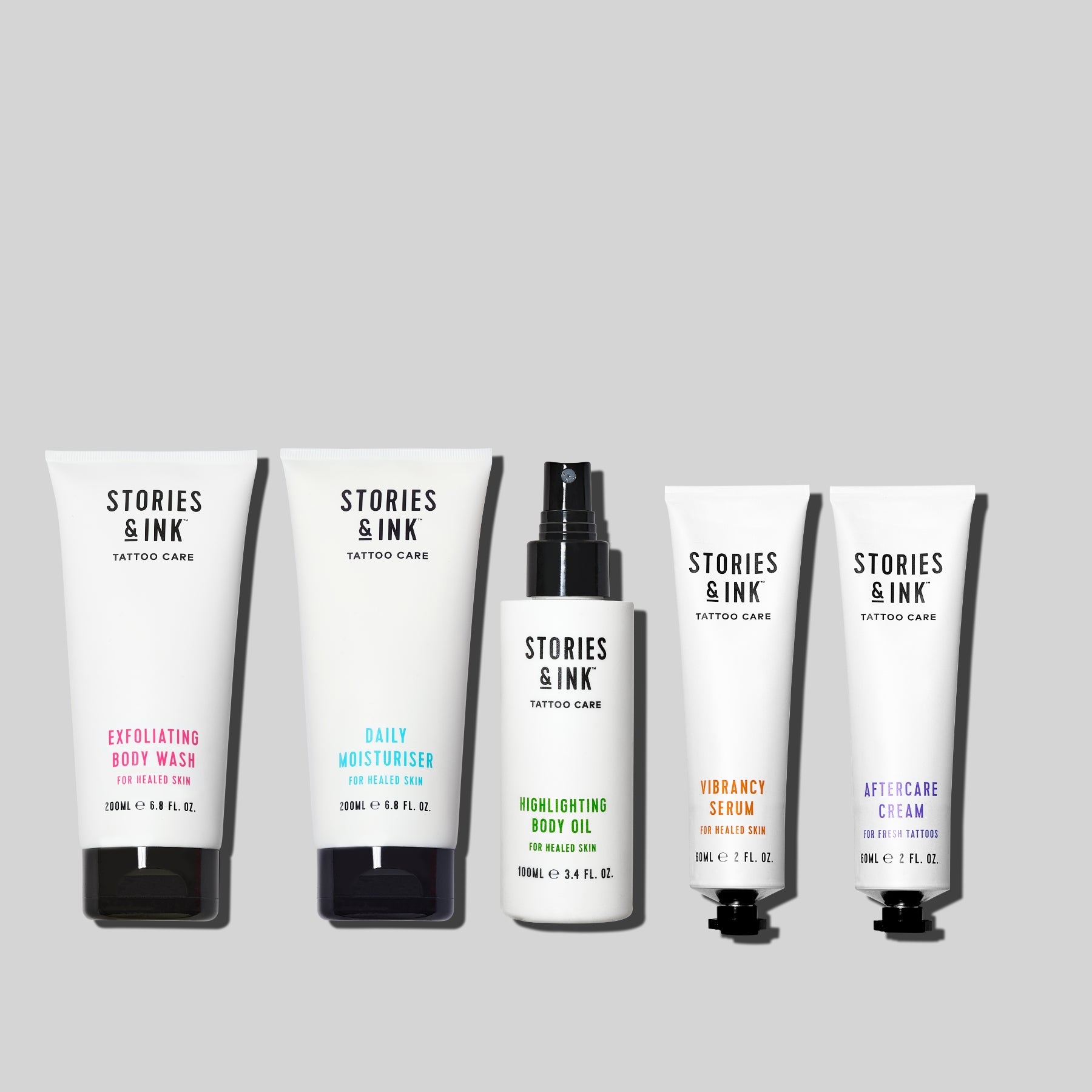


The best tattoo aftercare in 2026 is fragrance-free, vegan and breathable, with actives that calm skin rather than just coat it. For fresh tattoos, artists increasingly recommend purpose-made creams like the Stories & Ink Aftercare Cream over petrolatum ointments such as Bepanthen or Aquaphor, which sit heavy on healing skin.
You spent months waiting for the appointment. Hours in the chair. A number you'd rather not repeat to your bank. And then the whole thing gets handed over to whatever tub is lurking at the back of your bathroom cabinet.
Ask any tattoo artist what ruins more fresh tattoos than shaky linework and they'll tell you: aftercare. So we did the thing nobody in this category seems willing to do. We lined our own product up against the ones your artist, your mate and your group chat keep recommending, and compared them honestly. Credit where it's due, receipts where it isn't.
Key takeaways
- Fragrance is the most avoidable cause of irritation on a healing tattoo. Whatever you use for the first 2 to 3 weeks should be fragrance-free, no exceptions.
- Petrolatum ointments (Bepanthen, Aquaphor, Vaseline) form a heavy, occlusive seal. They can work in very thin layers, but they're easy to overdo and were never designed for tattoos.
- The Stories & Ink Aftercare Cream is fragrance-free, vegan, non-occlusive and built around three calming, anti-inflammatory actives: Bisabolol, Panthenol (Provitamin B5) and Cardiospermum Halicacabum.
- Aftercare and maintenance are different jobs. Fragrance-free products only until your tattoo is fully healed (2 to 3 weeks), then switch to daily maintenance to fight fade.
What actually makes a good tattoo aftercare product?
A fresh tattoo is thousands of tiny punctures in your skin. For the first couple of weeks it behaves like a healing wound, which means the rules are different from normal skincare. Here's the checklist we'd use even if we didn't make the stuff:
Fragrance-free. Fragrance (natural or synthetic) is the single most common irritant on compromised skin. It has no job to do on a healing tattoo except smell nice while it stings.
Breathable, not occlusive. Skin heals best with moisture and airflow. Thick petrolatum seals trap heat and sweat against the wound, which can lead to clogged pores, bubbling and patchy healing.
Actives that calm, not just coat. Look for ingredients with actual evidence behind them for soothing and barrier repair: Bisabolol, Panthenol, Cardiospermum. "Moisturising" alone is a low bar.
Vegan and hypoallergenic. Lanolin and beeswax are animal-derived and both show up on sensitiser lists. On intact skin, most people are fine. On a fresh tattoo, why gamble?
Made for tattoos. Nappy rash cream can heal a nappy rash beautifully. That was never the question.
Tattoo aftercare compared: the 2026 table
| Product | What it is | Fragrance free | Vegan | Texture on fresh ink | Made for tattoos |
|---|---|---|---|---|---|
| Stories & Ink Aftercare Cream | Non-occlusive cream with Bisabolol, Panthenol and Cardiospermum | Yes | Yes | Light, breathable | Yes |
| Bepanthen | Petrolatum and lanolin nappy rash ointment with Provitamin B5 | Yes | No (lanolin) | Heavy, occlusive | No |
| Aquaphor | Petrolatum-based healing ointment with lanolin alcohol | Yes | No (lanolin alcohol) | Heavy, occlusive | No |
| Hustle Butter Deluxe | Shea, mango and coconut butter balm, used in-session and after | No (noticeable scent) | Yes | Rich, buttery | Yes |
| Mad Rabbit | Modern tattoo balm and gel range | Mostly scented | Yes | Light to medium | Yes |
| Tattoo Goo Original | Traditional herbal salve with beeswax and lavender oil | No (lavender oil) | No (beeswax) | Waxy, semi-occlusive | Yes |
Now the honest bit. One by one.
Bepanthen on tattoos: the classic, and its catch
Bepanthen has been the default answer in UK studios for decades, and it earned that fairly: it's cheap, it's in every pharmacy, and its star ingredient (dexpanthenol, a form of Provitamin B5) genuinely supports skin repair. We rate Panthenol so highly it's in our own Aftercare Cream.
The catch is everything around it. Bepanthen is a nappy rash ointment built on an occlusive petrolatum and paraffin base with lanolin. That heavy seal is brilliant for keeping wee off a baby's bum. On a healing tattoo it traps heat and sweat, makes over-application almost inevitable, and the lanolin rules it out for vegans and can irritate sensitive skin. Good ingredient, wrong vehicle.
Aquaphor on tattoos: the American studio staple
If Bepanthen is the UK's default, Aquaphor is America's. Plenty of artists still hand it out, and used correctly (the thinnest possible layer, no more) it does keep a tattoo from drying out. It's affordable and reliably fragrance-free, which already puts it ahead of most of your bathroom shelf.
But it's roughly 41 percent petrolatum, and it contains lanolin alcohol, an animal-derived ingredient that's a recognised contact allergen. The most common Aquaphor failure we hear about isn't the product, it's the dose: people slather it on, the tattoo can't breathe, and healing goes soggy. A product that only works when you use almost none of it is a strange thing to call the best.
Hustle Butter on tattoos: loved in the chair
Full credit: Hustle Butter earned its place in studios. Artists love it as a glide during the session, it's vegan, and the shea, mango and coconut butter blend feels luxurious. If your artist works with it, that's a genuine endorsement of how it performs mid-tattoo.
For the healing weeks afterwards, we'd pump the brakes. It carries a distinct tropical scent, and rich butters sit heavier on broken skin than a purpose-built healing cream needs to. Lovely product, but it's doing its best work before you leave the studio, not in the fortnight after.
Mad Rabbit: the closest comparison
Mad Rabbit is probably the brand most often lined up next to us, and honestly, they've done a lot for this category: modern branding, vegan formulas, real investment in tattoo skincare as a serious idea. Respect.
Where we split is philosophy. Much of the Mad Rabbit range is scented, including products aimed at skin that's still healing, and the range is built US-first. Our view is simpler: nothing fragranced touches a tattoo until it's fully healed. That's why our Aftercare tier is fragrance-free by design, and the fragranced stuff lives strictly in our Maintenance range for healed skin.
Tattoo Goo: the heritage salve
Tattoo Goo has been around since the 90s and some artists still swear by it, which counts for something. It's a traditional herbal salve: olive oil, beeswax, cocoa butter, lavender oil.
That formula is also the problem in 2026. Beeswax means it isn't vegan, lavender oil is a fragrant essential oil on skin that wants zero fragrance, and the waxy base behaves semi-occlusively. It's a lovely piece of tattoo history. Your fresh ink deserves something written this decade.
And Vaseline? Put the tub down
Pure petrolatum is the most occlusive of the lot and has no active ingredients working for your skin at all. We've covered this one in full: read why you shouldn't put Vaseline on a new tattoo.
What we built instead: the Stories & Ink Aftercare Cream
We started Stories & Ink because tattoo aftercare was stuck between repurposed nappy cream and scented balms, and nobody was applying proper skincare logic to tattooed skin. Ingredient-led, no filler, no fragrance where fragrance doesn't belong.
The Aftercare Cream is fragrance-free, vegan, hypoallergenic and non-occlusive, so your skin gets moisture and airflow at the same time. Instead of one hero ingredient in a heavy base, it's built around three calming, anti-inflammatory actives:
- Bisabolol, derived from chamomile, to soothe redness and irritation
- Panthenol (Provitamin B5), the same repair ingredient Bepanthen is famous for, without the petrolatum around it
- Cardiospermum Halicacabum, a botanical that helps calm dry, sensitised skin
Pair it with the Aftercare Foam Cleanser, a gentle wash with Bulbine Frutescens that clears plasma and residue without stripping healing skin. Together they're the Tattoo Aftercare Duo, which is the routine most of our artists hand to their clients.
The routine artists actually recommend
- Wash: twice a day with lukewarm water and a fragrance-free cleanser. Clean hands, no scrubbing, pat dry with clean paper towel.
- Cream: a thin layer of Aftercare Cream 2 to 3 times a day. Thin means thin. Your tattoo should never look glossy or wet.
- Protect: loose clothing, no swimming or soaking, and keep it out of the sun. Here's what you need to know about new tattoos and swimming.
- Switch at healed: once all swelling, redness, itching, flaking and scabbing have fully subsided (usually 2 to 3 weeks), your tattoo is healed and the job changes from healing to fighting fade. That's when the Daily Tattoo Moisturiser and Vibrancy Serum come in. Never before.
For the full day-by-day walkthrough, read the complete guide to tattoo aftercare.
Frequently asked questions
Can I use Aquaphor on a new tattoo?
You can, and many artists still recommend it, but only in the thinnest possible layer. Aquaphor is around 41 percent petrolatum, so over-applying seals the tattoo off and traps heat and sweat. It also contains lanolin alcohol, an animal-derived ingredient that can irritate sensitive skin. A breathable, fragrance-free tattoo aftercare cream is the safer default.
Is Bepanthen good for tattoos?
Bepanthen's key ingredient, Provitamin B5, genuinely supports skin repair, which is why it became the UK studio default. But it's a nappy rash ointment with an occlusive petrolatum and lanolin base, so it sits heavy on healing ink and isn't vegan. Purpose-made tattoo aftercare gives you the Panthenol without the grease.
Can I put Vaseline on a new tattoo?
No. Vaseline is pure petrolatum, the most occlusive option there is, with no active ingredients to support healing. It seals the tattoo off from airflow, traps bacteria and moisture, and can contribute to patchy healing and fading. Use a breathable, fragrance-free aftercare cream instead.
Can I use normal moisturiser or lotion on my tattoo?
Not while it's healing. Most everyday lotions contain fragrance, and many contain alcohols or actives that don't belong on broken skin. For the first 2 to 3 weeks, stick to fragrance-free products made for compromised skin. Once fully healed, a tattoo-specific daily moisturiser will do more for vibrancy than a generic one.
What do tattoo artists recommend for aftercare in 2026?
Most artists now recommend fragrance-free, breathable products over traditional petrolatum ointments, alongside second skin film for the first days of healing. The consistent rules across studios: wash gently twice a day, apply a thin layer of fragrance-free cream 2 to 3 times a day, no swimming, no sun, no scratching.
When can I switch from aftercare to regular tattoo skincare?
Once your tattoo is fully healed: roughly 2 to 3 weeks after your session, when all swelling, redness, itching, flaking and scabbing have completely subsided. From then on, the goal is preventing fade, so switch to a daily tattoo moisturiser and SPF whenever your ink sees sun.
Is coconut oil good for tattoos?
Once a tattoo is fully healed, coconut oil is a decent natural moisturiser, though it can clog pores on some skin. On a fresh, healing tattoo it's not ideal: it lacks the calming actives healing skin needs, and pure oils can sit heavily. A dedicated fragrance-free aftercare cream is the better tool for the first few weeks.
How often should I apply tattoo aftercare cream?
A thin layer 2 to 3 times a day for the first two weeks, then 1 to 2 times a day until fully healed. More isn't better: over-moisturising can cause bubbling and soggy healing, while too little leads to tight, itchy scabbing. Your tattoo should feel comfortable, never greasy.
Stories & Ink is a UK tattoo skincare brand: fragrance-free, vegan aftercare for fresh tattoos, and a dedicated Maintenance range that keeps healed ink vibrant. Artist-approved and used by studios and collectors worldwide. Questions? info@storiesandink.com